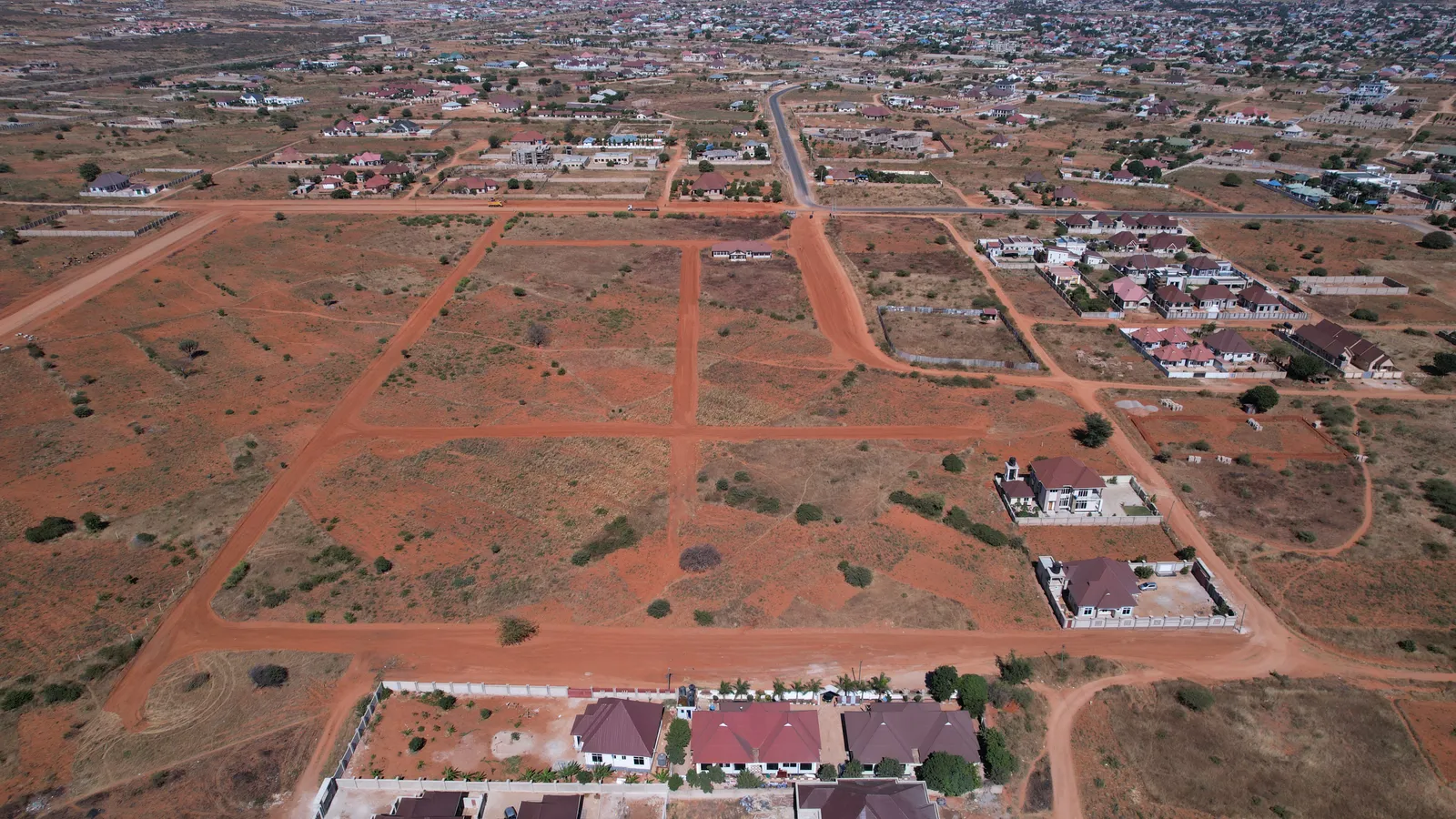
Under construction
Residential
Kisasa Residency
by Kisarawe 2 Industrial Park
Premium residential development on Dodoma’s outskirts, offering low‑density plots for high‑end and executive living.
Plot
Dodoma
Price on request
Dodoma has been the capital of Tanzania since 1996, although the effective transfer of government functions from Dar es Salaam continues. The city had 765,179 inhabitants at the 2022 census and covers 2,669 km², of which 625 km² is urbanized. Located in the centre of the country, it is experiencing rapid demographic growth, particularly in peri-urban wards. The local property market offers more accessible prices than Dar es Salaam or Arusha, with a diverse supply of rental housing and building plots.
No listings found in Dodoma yet. Check back soon!
Residential
by Kisarawe 2 Industrial Park
Premium residential development on Dodoma’s outskirts, offering low‑density plots for high‑end and executive living.
Dodoma
Price on request
Dodoma was designated capital of Tanzania in 1974 as part of a territorial rebalancing project. The effective transfer of institutions began in 1996 and accelerated with the inauguration of the new State House in 2023. The city had 765,179 inhabitants at the 2022 census, up from 410,956 in 2012, representing 86 % growth over ten years, according to Wikipedia. It covers 2,669 km², of which 625 km² is urbanized.
The construction of Msalato International Airport is supported by a USD 272 million financing package backed by the African Development Bank and other development partners, according to the African Development Bank. The project includes a 3.6 km runway and a terminal handling 1.5 million passengers per year. According to Wikipedia, as of 2026 construction remained underway, according to Wikipedia.
The historic city centre includes neighbourhoods such as Tambukareli, Madukani and Kilimani, which concentrate administrative and commercial functions, according to Wikipedia. The peri-urban areas of Ihumwa and Msalato are experiencing the strongest demographic growth, with respective increases of 613 % and 534 % observed in recent studies. These wards mainly accommodate rental housing for middle-income households.
The property supply comprises several typologies: standalone villas in planned residential areas such as Kisasa, upmarket apartments near the centre, multi-unit rental houses (often called « nyumba nzima »), and serviced or unserviced plots on the periphery. The Kisasa Residency project, developed by Kisarawe 2 Industrial Park, is under construction in the area.
Property prices in Dodoma remain lower than in Dar es Salaam and Arusha. According to 2025 market data, residential properties trade between USD 700 and 1,200 per square metre, compared with USD 3,820 in premium Dar es Salaam neighbourhoods, according to The Guardian (Tanzania). Rents for small rental units vary according to standing and location. Research conducted in 2019 by the Centre for Affordable Housing Finance in Africa shows that rents for one-bedroom units with a living room in Dodoma were lower than in Dar es Salaam, although areas near government institutions command higher levels.
Tanzania's annual housing deficit is estimated at 150,000 units, which supports rental demand, according to The Guardian (Tanzania). Rental yields in Dodoma range between 6 % and 8 % according to sector analyses, according to The Guardian (Tanzania); these levels are presented descriptively and do not constitute an invitation to invest.
All land in Tanzania is publicly owned and vested in the President as trustee, in accordance with section 4 of the Land Act, Cap. 113 R.E. 2023. Section 20 of the same Act prohibits non-citizens from occupying land, except for investment purposes and through derivative rights issued by the Tanzania Investment Centre, now the Tanzania Investment and Export Promotion Authority (TISENZA).
A foreigner wishing to acquire a land interest must therefore register a project with TISENZA and obtain a derivative right. This mechanism also applies to companies whose majority shareholders are foreign. The derivative right may be mortgaged, subject to prior approval by the Commissioner for Lands.
A property transaction in Tanzania involves several fees: stamp duty at 1 % of the property value, registration fees at 0.25 %, and capital gains tax at 3 % for developed land or 10 % for undeveloped land, according to Multilaw. A Certificate of Title, issued under the Land Registration Act, Cap. 334 R.E. 2023, constitutes legal proof of ownership.
Several precautions are necessary in Dodoma. First, verify the land status: the distinction between village land, general land and reserved land determines the possibilities of occupation and transfer procedures. Second, ensure the viability of peripheral plots: access to water, electricity and roads remains uneven across neighbourhoods.
For rentals, Tanzanian law governs the landlord-tenant relationship. In case of non-payment, the landlord must issue a notice of intention to terminate of at least 30 days, in accordance with section 104 of the Land Act, according to FB Attorneys. This notice must state the amount of arrears and the payment deadline. In the absence of settlement, the landlord may apply to the competent land court for an eviction order. Forced eviction without a court decision is an offence.
It is recommended to engage a notary or lawyer to draft any lease contract or deed of sale, and to verify the authenticity of the Certificate of Title with the land registry before any transaction.
The Imonga page for Dodoma indicates, as of the consultation date, zero published listings. The platform covers several West African countries and offers search tools by property type. For Tanzania, no listing is currently recorded on the consulted page, and the section by property type appears empty. The links to projects and to the Tanzania real estate pages allow users to follow changes in supply, although no listing is available today.
No, the Land Act, Cap. 113 R.E. 2023 prohibits non-citizens from directly holding land. A foreigner may obtain a derivative right through the Tanzania Investment Centre for a registered investment project. Consulting a lawyer is essential.
The Certificate of Title, the Right of Occupancy or Derivative Right, and the land rent clearance certificate. A search at the land registry confirms authenticity and the absence of mortgages.
The landlord must first serve a notice of at least 30 days, according to FB Attorneys. If the tenant does not settle the arrears, the landlord must apply to the land court for an eviction order. The use of force without a judicial decision is illegal.
The peri-urban wards of Ihumwa and Msalato show the highest demographic growth rates. The Kisasa area hosts planned residential developments, including villas and building plots.